*
Cohousing and Variable Energy
Over the years, we’ve become increasingly aware that most traditional housing isn’t good for people with limited/varying energy. Through our own experiences, we’d seen how housing may not only hamper recovery but actually cause relapse.
Cohousing could make living with unreliable energy easier to manage, steadier, even enjoyable. It can also make use of eco-aware techniques such as permaculture to support a balanced lifestyle..
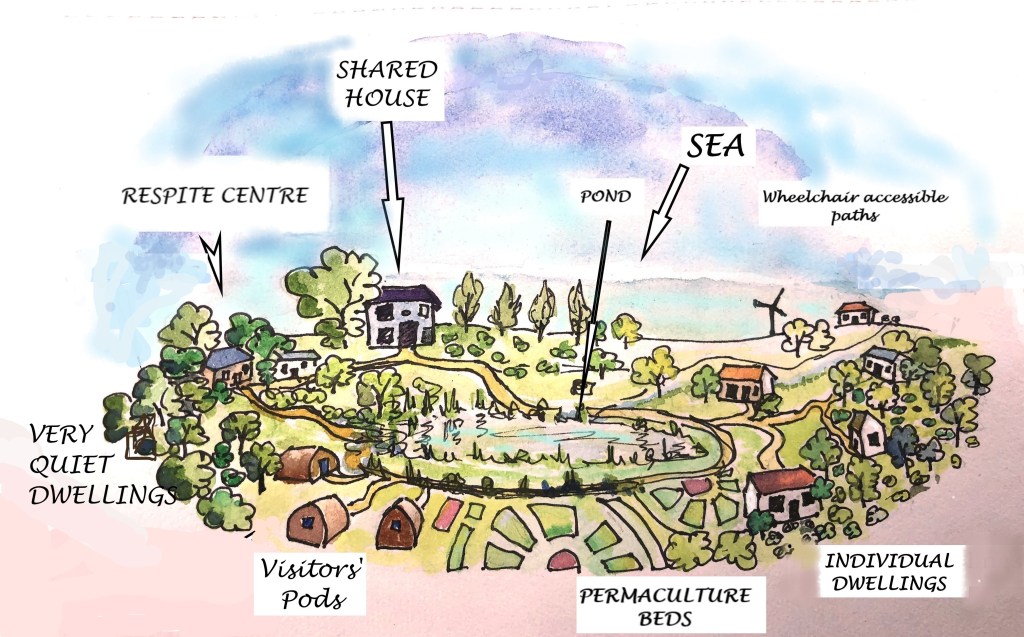
Our ultimate aim is to have a mini village-like structure with small individual dwellings and a shared house, as wheelchair accessible as possible. We intend to be eco-aware and physically centred around permaculture beds to support as gently healthy a lifestyle as practical.
We’re keen to include anyone interested in energy management – whether severely affected or fully healthy (whatever that means) – an inclusive group that enables a balance between solitude and community.
At it’s heart, but in as quiet a spot as possible, we plan to have a retreat centre for more severely affected people, which could provide part-time employment for people with more energy.
*
On this page we discuss organisation, housing types, care issues, children and money. See our Permaculture and Social Permaculture page for how we intend to use permaculture for gardening and managing group energy.
Organisation
As energy issues are so varied and variable – between people and within individuals’ experience – with different abilities, management techniques, sensitivities, limits etc – it’s important that our project works with this. Both the housing itself and, probably most importantly, how we organise ourselves in setting it up.

So, we have designed a Hare and Tortoise site to help us establish a core foundation that is flexible enough to allow for relapses and strong enough to be resilient and maintain momentum without anyone getting drained. And to ensure that those with more energy don’t feel they’re ‘carrying’ others. Email us if you’re interested.
We think permaculture principles could be very useful to organising, as well as, hopefully, food, health and natural therapy.
The specific structure will depend on the individuals involved and how many there are. Each person’s input needn’t be consistent (as the core organisation should allow for changing energy levels and other commitments), as long as they’re motivated by the project, and are open to sharing ideas cooperatively.
Understudies
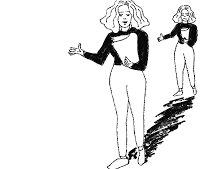
But, for the time being, we trying out a system similar to ‘understudies’, which has been used elsewhere for people with ME running a business. People who aren’t able to undertake tasks consistently follow the work of someone working on a particular issue, like an understudy does with an actor. So, if the acting person needs a break, an understudy could briefly update the group without the need for exhausting explanations.
See the section on ‘Cooperating with Different Energy Levels’ for more about this.
The most essential quality is willingness to support each other by respecting and valuing each other’s limits and strengths, as well as our own.
Official structure
Once the core group is formed, we’d need to decide which official form of co-op would suit us best. One type requires capital input from members and the other relies more on funding…seeing as so many people with ME don’t have much money (for obvious reasons), we’ll probably go for one of the latter. Then, assuming we don’t have enough capital between us to set it up, we could start applying for funding . . .
Housing
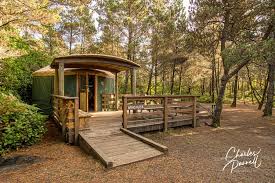
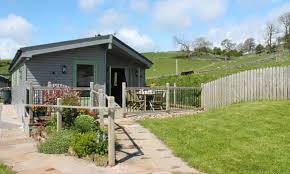
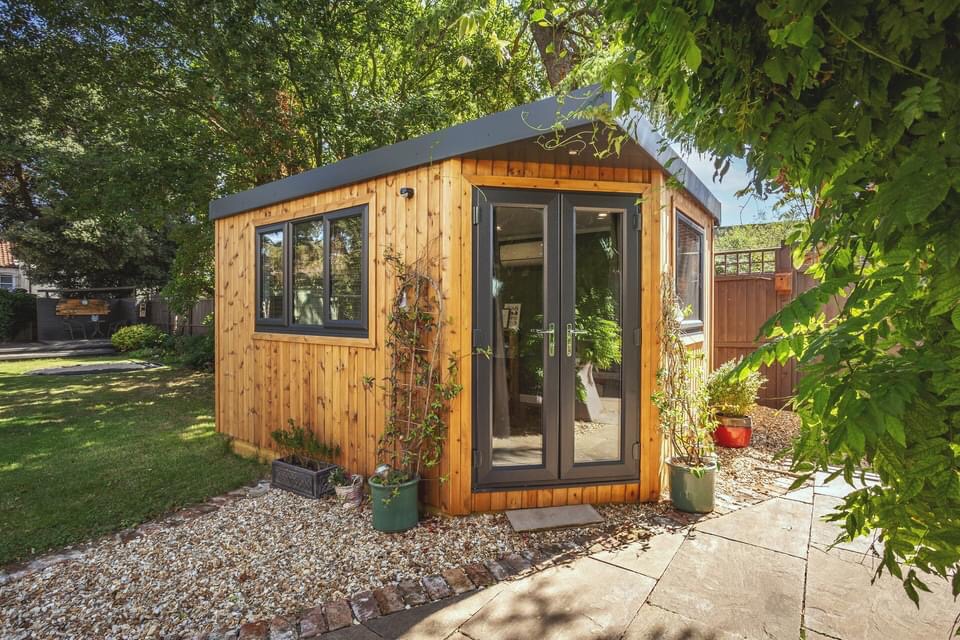
Ideally, we’re aiming at rural housing that includes a shared house for people who prefer this, and several small individual ground floor dwellings for those who prefer that – making it possible to have community and solitude.
In terms of planning permission, we’re more likely to be able to get permission for building new individual eco-dwellings if there is already a residential building on the site, even if it’s derelict.
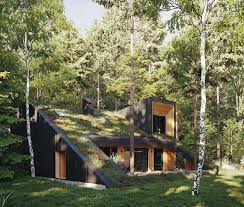
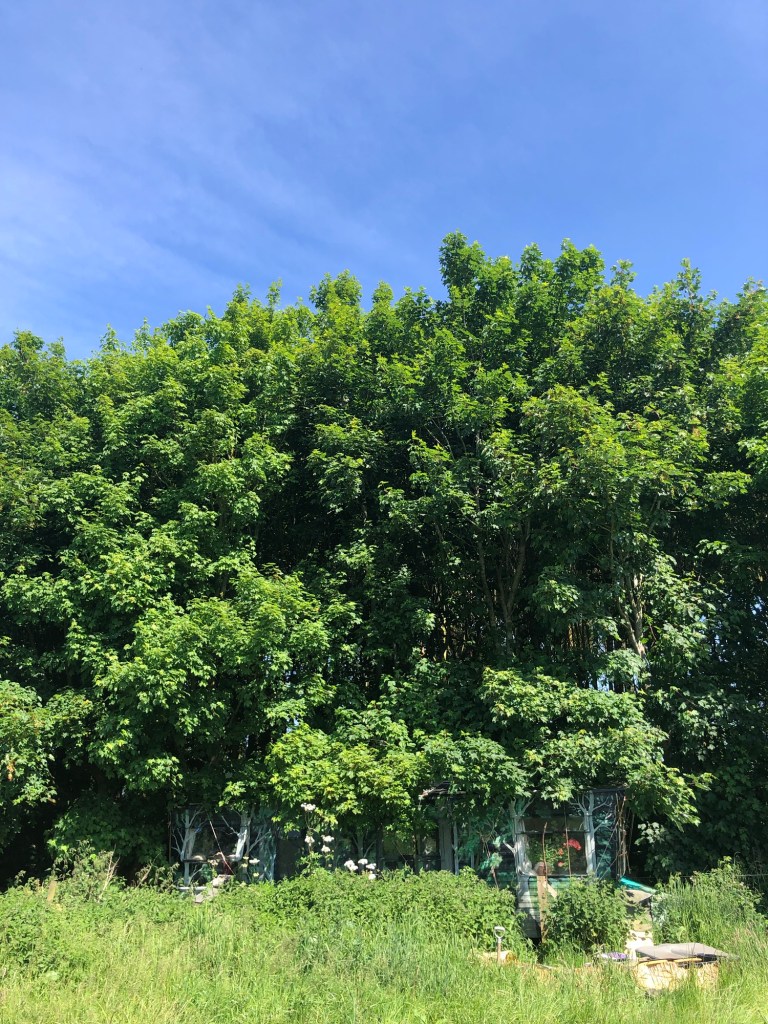
These could be eco houses or biophilic structures (designed and built with health in mind, e.g., purpose built cob houses), with people with chemical sensitivities in mind. Or static caravans as temporary/cheaper options – these are very convenient and can be painted to camouflage them. But they would all be accessible, as eco-friendly as possible, and designed to suit people with various sensitivities – noise light chemicals…sometimes just the presence of other people however much we love them …
Eventually, we aim for the project to be centred around a small respite centre for people needing more support that would pay for it’s running costs by charging according to a sliding scale. This would be designed with post-travel exhaustion and ‘new place’ anxiety in mind.
Ideally, this would function as a steppingstone to more independent living whilst providing work for more energetic members.
*
Care issues
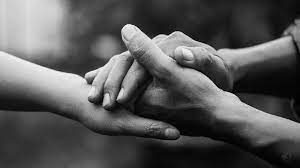
As some people would share care needs, we would be able to work out good care packages for those that need them. These could also provide part-time employment for other members.
Obviously, it’s important that other members, whether they have energy issues or not, shouldn’t be expected to look after more severely affected people unless by an agreed/financial arrangement. It’s equally important that the community isn’t dominated by those with more energy.

.
Balanced community
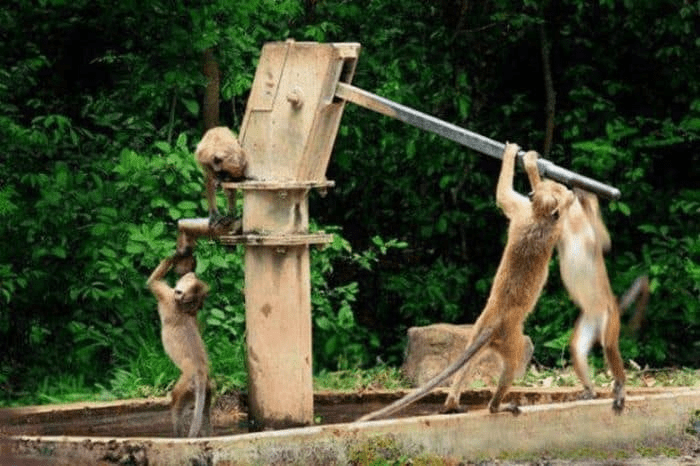
We feel the community would be more balanced if it’s open to all, whatever their health status. But we’d assume anyone wanting to join would be interested in managing energy … and we’d organise to ensure that no one felt they were responsible for others’ welfare (except by an accepted arrangement).
We’re confident this can work positively in terms of balance within the community, by recognising that interdependence needs to be worked out with clear boundaries. And by valuing the stabilising contribution people with low energy can bring.
.
Children
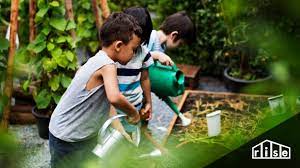
We would like to include children as they can be very heartening and inspiring – and an essential part of a balanced community. So we plan to use several strategies to ensure the community is mutually beneficial and peaceful for people with sensitivities as well as for children.
Options include trial stays and siting children’s homes away from where more sensitive people live (see sketch). We’d also like to have a buddy system whereby parents have support, and each child has someone they feel they can share with if issues arise.
Ensuring the community is a safe place for sensitive people will always be a priority.
***
We don’t intend to be self-sufficient using permaculture and forest gardening, our focus on nature would be mainly therapeutic – as the hard work involved in self-sufficiency could defeat our overall aim.
Money

We’re keen that our structure will mean that people without capital resources are able to be involved, whatever co-op model we choose…see the Funding page ….
Contact us if you’re interested – resilientcohousing@gmail.com
4 responses to “Our Approach”
 AnonymousMar 21, 2022 at 7:41 pmEditThis looks very well thought through
 Resilient Cohousing
3 responses to “Our Approach 2024”
This is very inspiring- thanks
LikeLike
this looks very interesting – with much food for thought. I think it could be a wonderful community
LikeLike
Quite interested. I don’t have ME but have cared for and still visit one who has the chronic form.
I expect my own needs to change in the future, and I’m looking towards finding accommodation on 1 or 2 floors instead of the 3-level steep stair house I’m in. I’m 70 and slowing down, though still fit and able. I’m good at sharing, getting involved and being supportive. I value time away from people too.
Natural surroundings, not far from the sea would be ideal.
Visual challenges limit my use of screens.
LikeLike